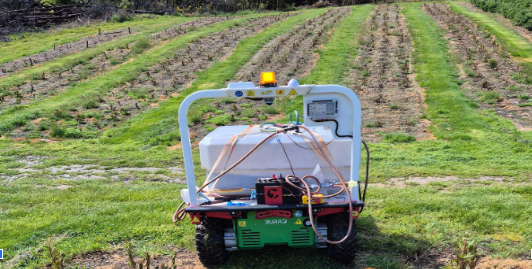
Hey team, I'm back with an update on our little robot helper, the Burro. A few months ago, I shared our excitement about bringing this autonomous robot onto our farm, and I promised I'd let you know how it went.
Well, if you're picturing a triumphant tale of a shiny new robot zipping through the fields, perfectly executing tasks with the precision of a Swiss watch, you might need to adjust your expectations. This story is less about a robot takeover and more about a humbling lesson in the unpredictable nature of farming—and a powerful reminder that some things just can't be rushed.
The Great Flood of 2025
Just as we were getting to know our new robotic friend, Mother Nature decided to throw a spanner in the works. Or, more accurately, two.
We live and work in the Upper Moutere, Nelson, a beautiful part of New Zealand, but like many places, it has its quirks. In our case, that's heavy clay soil. It holds on to water with a stubborn grip, and in late June, we had a one-in-100-year storm. Yep, the kind you read about in history books. So, what do you think happened two weeks later?
You guessed it. Another one-in-100-year storm.
I'm no mathematician, but two hundred-year storms in two weeks just sounds like a lot of water. It turned parts of our farm into a muddy, boggy mess. Even though our farm is on rolling hills, meaning a lot of the water flowed away, those clay soils held on, particularly at the bottom of our rows.
And guess what doesn't do so well in a foot of sticky, wet mud? Robots. Or tractors. Or pretty much any farm equipment heavier than a gumboot. We just had to wait for things to dry out.
As frustrating as it was, it brought a truth into sharp focus: a robot can't swim. It can't magically navigate through conditions that even our heavy machinery would get bogged down in. This wasn't a failure of technology; it was a simple, stark reminder that farming is fundamentally connected to the earth, and sometimes, you just have to work on its timeline, not your own.
The Unspoken Language of Weeds
As the ground slowly dried and the temperatures rose with the arrival of spring, our farm came alive. Peonies started to push their way out of the ground, and with them, the weeds. It was a race against time, and our priority shifted from "let's train the robot" to "let's not lose our crop to an onslaught of green invaders."
This meant that our initial plans for extensive robot training were put on the back burner. We needed to be efficient, and that meant using our limited time and resources for the most pressing task.
That said, we did manage to make some progress, and in the spirit of this being an informal report, I have some good news!
We've been using the Burro to help with our spot weeding, and it's been an absolute game-changer. The robot allows one person to do a job that used to require two, and that has been a huge help in our battle against the weeds. So, even though it hasn't been the full-scale, autonomous farmhand we envisioned, it's already proving its value by making our team more effective and helping us stay on top of a massive job. It's a bit like having a really good, very quiet, and incredibly focused apprentice who never complains.
A Robot's Memory and the Problem of Location
But here's a funny thing we've learned. When we first recorded the routes for the Burro, we did it before the peonies had pushed through the dirt. Now, how the robot works is that it learns a specific route and then, once it's locked in, it can follow it autonomously. Simple, right?
Not so much. As the peonies started to grow, they emerged in slightly different spots than we had initially anticipated. It wasn't a huge difference, but a few centimeters here and there meant that if we ran the Burro on its original route, it would run right over our precious plants.
Not a good look, and certainly not the outcome we want.
So, what does this mean? It means we're back to square one. We've had to go back and re-record the routes, this time with the peonies fully visible in their final locations. It’s an extra step we hadn't planned for, but it’s a crucial one.
It’s a great example of a simple truth: even the most advanced technology needs a human touch. This fully autonomous robot is amazing at following instructions, but it can't adapt or use common sense. It doesn't know what a peony is, or that running over it is a bad idea. That’s our job—to guide it, to teach it, and to course-correct when the real world throws a curveball. It’s not about turning the farm over to the machines; it’s about using the machines to help us be better farmers.
Ultimately, this whole experience has been a bit like a big, complex science experiment. We've had unexpected variables (those storms!), surprising results (the spot weeding success), and a lot of learning. We're still in the early stages, but I'm more confident than ever that this technology will make a huge difference for our farm in the long run.
And as promised, here's a little video of the Burro in action, doing its thing on the newly mapped route!
What about you? Have you ever had a new piece of technology that threw you a curveball? I'd love to hear about your own "robots can't swim" moments!